By Heather Clarke, WILPF Victoria
Victorian and Tasmanian WILPF members were recently very fortunate to hear from two inspiring women peacebuilders at an event co‑hosted by the University of Melbourne’s Initiative for Peacebuilding and the Uniting Church of Australia, Synod of Victoria and Tasmania
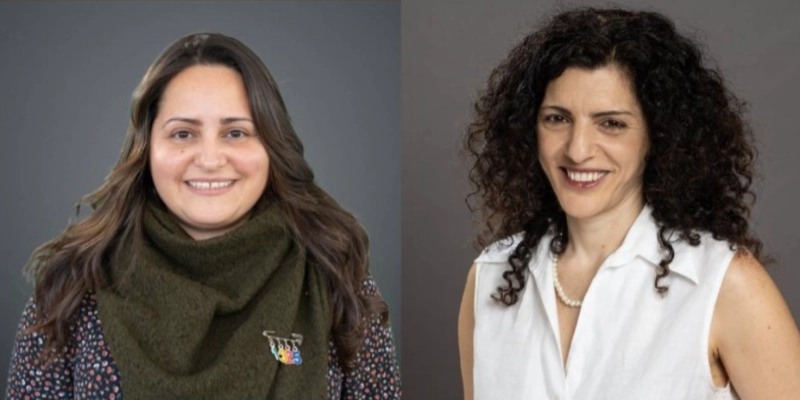
Dr Nida Shoughry is a scholar‑practitioner working at the intersection of feminist peacebuilding, conflict transformation, and women’s political participation. She co‑directs the Centre for Women, Peace and Security at Itach‑Ma’aki (Home • WPS CENTER) and co‑leads the 1325 Joint Palestinian‑Israeli Steering Committee — one of the few Israeli‑Palestinian collaborative bodies to have maintained active operations throughout the current conflict. Dr Shoughry has co‑trained and accompanied over 100 Palestinian and Israeli women leaders in preparation for peace negotiations and Track 2 diplomacy and has collected more than 2,000 online accounts of Palestinian women documenting survival, resistance, and visions for peace. See 1325 – Collecting Women’s testimonies for policy change • WPS CENTER
Dr Tsameret Levy‑Daphny is an expert on Turkey and the Middle East, and a lecturer and strategic advisor with over 25 years of experience in Israeli academia and civic initiatives. She previously headed the Turkey Forum at the Van Leer Jerusalem Institute, where she led research programmes and regional collaborations. She is a member of Forum Dvora – Women in Foreign Policy and National Security and serves on the steering committee of the 1325 Forum for a Political Agreement.
Half the Story, None of the Headlines: Palestinian and Israeli Women Reclaiming Their Space featured Nida and Tsameret sharing their personal and professional insights into how women, despite being sidelined in public imagination and formal decision‑making, are actively reclaiming their space in peacebuilding work.
As members of the1325 Joint Israeli-Palestinian Steering Committee their work is grounded in the conviction that ‘war is the most devastating force in women’s lives, on every side of this conflict. The structural barriers to women’s inclusion, including the privileging of military expertise over civilian and community knowledge, the silencing of women in public life, and the normalization of armed presence, diminish all of us.’
Nida spoke about how after October 7, Steering Committee members experienced:
“nothing but Fear… but we kept meeting and grieving together and decided to reframe how we presented ourselves. We highlighted our expertise in conflict resolution and peace negotiations and sought meetings with EU stakeholders. Our approach is to share our personal stories of war experiences, highlighting that war is not the way to safety.”
“The authentic voices of women sharing these powerful human stories has created credibility for the Steering Committee to present policy papers and recommendations to decision makers focusing on 1325 inclusion and delivery and contribute to the drafting of a National Action Plan.”
“The goal of UNSCR 1325 is not to count women at the table. It is to ensure that the presence of women changes what happens at the table, that their lived knowledge shapes agreements, and that those agreements are therefore more likely to hold.”
The Centre has links with women peace negotiators all over the world and works with diaspora women as well as seeking opportunities to meet directly with US officials. Nida and Tsamaret’s visit last month included meetings in the ACT where they requested an ongoing briefing channel with the Australian government.
Their Melbourne events also included a Roundtable hosted by Melbourne Uni’s Initiative for Peacebuilding with Nida and Tsamaret sharing their reflections on Palestinian and Israeli Women Peacebuilding, and a Peace-Building Conference hosted by the Uniting Church of Australia, Synod of Victoria and Tasmania where Nida and Tsamaret were the keynote speakers.
Nida shared that for the members of the Steering Committee remaining hopeful about a just solution to the Israel-Palestine conflict is ‘a question of survival…we can’t afford not to be hopeful.’ In response to a question about the potential for a two-state solution, Nida responded ‘Rather than worrying about the shape and size, we need to end the harsh reality on the ground….Israel needs to end its occupation, this is the main thing…then allow the local communities work out how they want to live and be.’