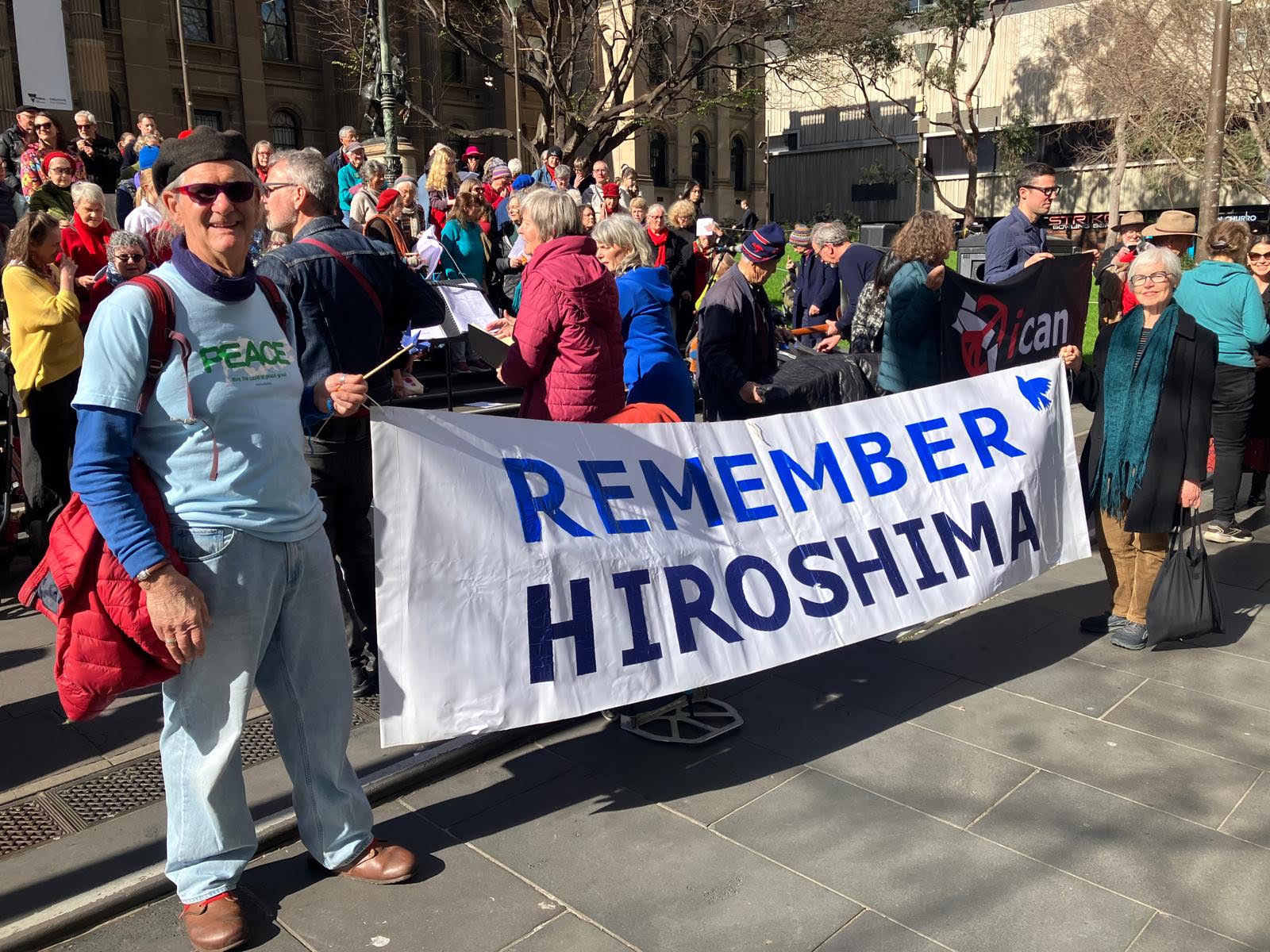
Photo above: WILPF Victoria member Heather Clarke with friend.
It was 81 years ago on the 6th of August 1945, the United States dropped a uranium bomb over Hiroshima. More than 140,000 people had died and 70% of Hiroshima City burned and was levelled to the ground. Then three days after bombing Hiroshima the US attacked Nagasaki with plutonium bomb, this killed 74,000 people with the ground temperature reaching to 4000°C and radioactive rain drenched Nagasaki City.
In Canberra WILPF members joined with fellow peace activists, politicians and Ambassadors at the Canberra Rotary Peace Bell, in NSW WILPF members joined the Sydney rally and marched to the Defence Department, in SA and in VIC WILPF members also participated in local events.
In Canberra, speakers included Alastair Hill from the Medical Association for Prevention of War (MAPW), Ludmilla Kwitko from the Women’s League for Peace and Freedom (WILPF) and Tara Gutman from the International Campaign for the Prohibition of Nuclear Weapons (ICAN). You can read Ludmilla’s address here.
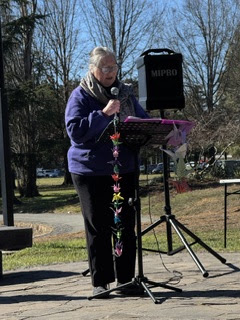
Photo: Ludmilla Kwitko addressing attendees at Canberra.
In Canberra, speakers included Alastair Hill from the Medical Association for Prevention of War (MAPW), Ludmilla Kwitko from the Women’s League for Peace and Freedom (WILPF) and Tara Gutman from the International Campaign for the Prohibition of Nuclear Weapons (ICAN). You can read Ludmilla’s address here.
The final speaker was His Excellency Mr Kazuhiro Susuki Ambassador to Australia from Japan, who reminded us of the utter damage to the two cities caused by the nuclear bombs. He then spoke of the Nara Treaty, (officially the Basic Treaty of Friendship and Cooperation) signed by Australia and Japan in June 1976, in which the first article reads:
‘The basis of relations between Australia and Japan shall be enduring peace and friendship between the two countries and their peoples.’
He sees this as demonstrating what can happen if enemies can become friends.
In NSW, one of the speakers at the rally, Dr Ruth Mitchell, a 2017 Nobel Peace Prize winner, doctor and neurosurgeon, had called the attention of the participants to the following nuclear tragedies in Australia as she said:
Closer to home, we must also grapple with the enormous and terrible legacy of British nuclear testing on unceded sovereign Aboriginal land at Maralinga and Emu Fields in the South Australian desert, and on the Montebello Islands. From 1952-1957, there were 12 major nuclear detonations in Australia in these three locations. The impact of these tests on First Nations people, military personnel, community members and on the environment continue to be felt. The responses for the affected communities and survivors has been wholly inadequate. There is a terrible responsibility in the hands of those who have performed these “tests” and we call for accountability.
Denis Doherty of the Hiroshima Day Committee said in his speech at the event: Australia must sign the UN Treaty for the Prohibition of Nuclear Weapons (TPNW). The Prime Minister prior to his winning the election promised to sign the treaty but he has not made any moves to do so and we are calling on him and the government do so now in this time of crisis.