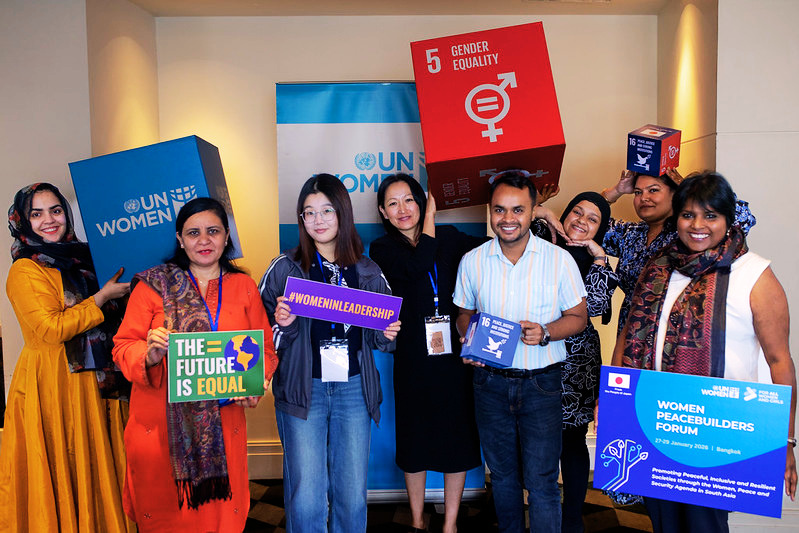
Photo: UN Women, Women Peacebuilders Forum, January 2026. Licensed under CC BY-NC-ND 4.0
WILPF Australia’s Move the Money campaign is calling on the government to commit to sustained investment in peacebuilding, including funding for a national program for peacebuilding research, training, and public education.
Peacebuilding addresses the root causes of conflict, prevents violence, and creates the conditions for sustainable, lasting peace.
It’s one of the best tools we have to prevent conflict, but the Institute for Economics and Peace reports that, globally, for every $200 spent on preparing for war, only $1 is invested in preventing violence.
What’s Australia’s ratio? Compared to military spending, how much do we invest in preventing violent conflict, building peaceful societies and sustaining the conditions for human security?
The answer should be straightforward for a government that has described peacebuilding as “one of the smartest investments a country can make” . But peacebuilding isn’t a budget line item, and anyone looking for the answer has their work cut out.
The OECD’s 2025 peer review of Australia’s development cooperation is a good starting point.
The review found that approximately 14.6% of Australia’s bilateral official development assistance (ODA) in 2023 was allocated to peace objectives. Applying this proportion to Australia’s reported ODA gives an estimate of around $600 million in peace-related bilateral aid in 2023.
Australia’s defence expenditure in the same year, 2023, was around $48.8 billion. That gives a pretty measly ratio: for every $1 spent preparing for war, only a few cents was spent on “peace objectives”.
But this is just an approximate conversion from published OECD data.
It reflects a broad set of aid activities classified by the OECD as contributing to peace, even if they weren’t specifically peacebuilding programs, and doesn’t necessarily capture activities across diplomacy, health, education, policing, gender equality, labour, humanitarian assistance, arts and culture, security cooperation, and peacekeeping initiatives that might contribute to peacebuilding.
We could work through individual programs across these portfolios to identify relevant investments, separate peacebuilding funding from other funded activities within mixed-purpose programs, reconcile different reporting systems, try to avoid counting the same expenditure more than once and maybe come up with a dollar figure.
But isn’t the lack of visibility for peacebuilding is itself a policy problem?
What governments name, fund and measure can be scrutinised, sustained and improved. So our call for sustained investment in peacebuilding is not just about dollars, but also about priorities.
WILPF Australia calls for sustained, identifiable and monitored investment in peacebuilding as an explicit government priority.
This could include a published definition and expenditure framework, a transparent annual account of relevant allocations and actual expenditure across government, and reporting against clear objectives and outcomes.
Sustained investment also means building the capacity to deliver on peacebuilding, and to grow public understanding of the value of peacebuilding at home and in our region.
That’s why we call for a commitment to establish a national program for peacebuilding research, training, and public education, so that all Australians can play a role in peace.
Learn more about Move the Money.