
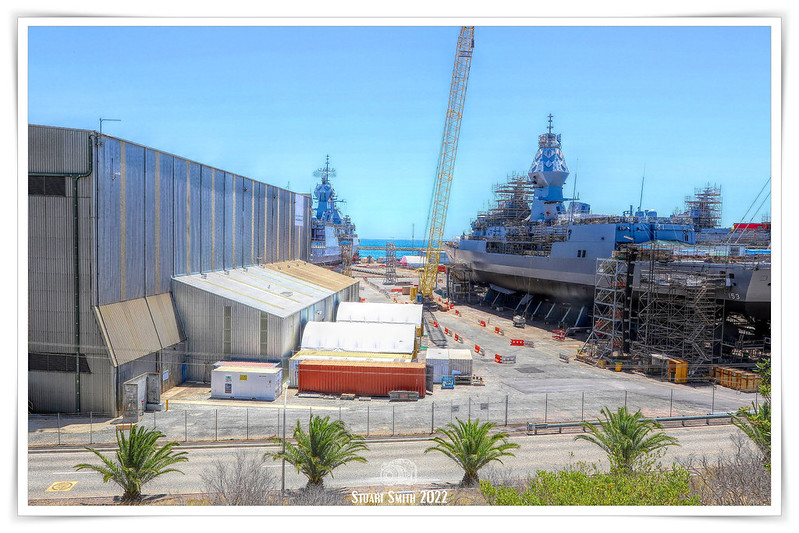
Photo: Australian Naval Ships Undergoing Refit, BAE Systems Australia, Quill Way, Henderson, Perth, Western Australia” by Stuart Smith. is licensed under CC BY-SA 2.0.
WILPF’s Move the Money campaign is calling for real accountability for military spending, including independently auditing jobs and economic multiplier claims.
Military spending is routinely justified to Parliament and the public with claims about domestic economic benefits, like jobs.
The Australian Government has promoted AUKUS as a jobs-creation machine, saying that there will be around 20 000 more jobs in the AUKUS nuclear-powered submarine program over the next 30 years.
Will these jobs materialise, and will the government – or anyone else – be held accountable for this claim?
It’s unlikely.
Analysis by ASPI of the joint strike fighter (JSF) global supply chain program – which was sold to the public as generating 5000 jobs in Australia – found that “at no time during the program” did jobs associated with the program approach that number.
And back in 2018, the Australian Government said the BAE Systems Hunter Class program would “contribute an estimated $17 billion to the national economy and generate over 6,300 full-time jobs across Australia at the program’s peak in 2028.”
In 2025, BAE said the Hunter program had contributed “$2.2 billion of economic activity to Australia’s economy to date.” That’s well short of the advertised $17 billion, though – who knows? – there could be bumper years ahead. Just this year the government gave a different set of jobs numbers: 2,500 currently employed on the Hunter program, with 5,000 indirect jobs “at peak”.
If our government wants to sell military spending as a jobs program, it should be accountable for those claims: publish the methodology, define the jobs being counted, commission independent audits, and report actual outcomes against the original promises.
But our call for scrutiny of jobs and economic benefit claims is not just about accountability.
Cloaking defence spending in economic benefit claims is problematic because it turns a political choice – what kind of security are we buying, for whom, and at what cost – into a technical one about jobs and growth.
That framing neutralises debate over whether the spending is necessary or desirable in the first place – and depoliticises the trade-offs involved.
Our feminist analysis challenges the assumption that economic growth and job creation are neutral measures of public benefit. We ask not just whether military expenditure produces jobs or economic growth – but what kind of economy it sustains, and whose labour and interests it privileges.
Learn more about Move the Money.