Move the Money
For real security, move the money.
Move the Money connects all of WILPF’s work by focusing on a simple question: what kind of security do we choose to fund? Shifting public resources from militarisation to care, justice and sustainability advances every aspect of WILPF’s mission.
Why do we want to Move the Money?
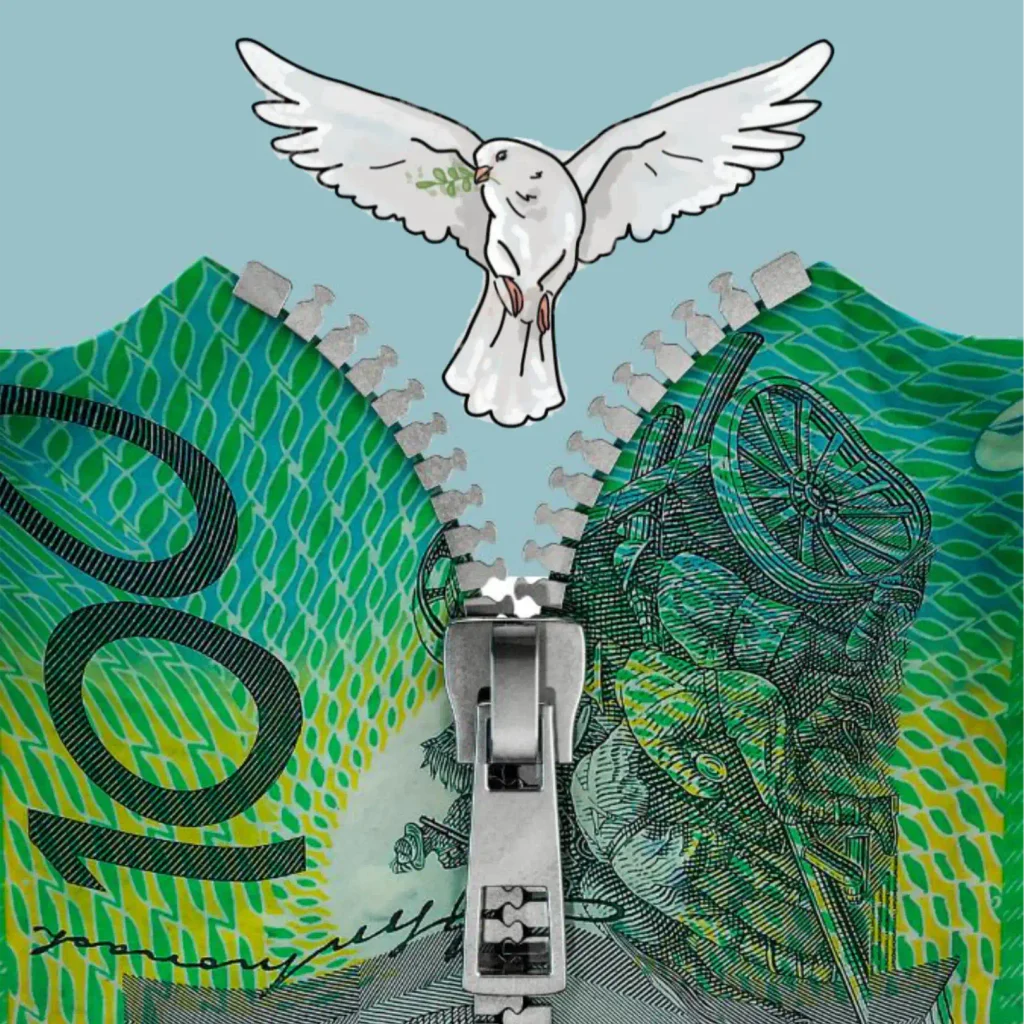
The Australian Government is spending billions on weapons and war while our basic needs go unmet. It’s time to move the money.
Real security depends on a society that is sustainable, fair, and inclusive. This is the kind of security most Australians want.
But rather than investing in the foundations of lasting peace, the government is wasting billions on weapons and war.
- Australia will spend around $425 billion on defence capability over the next decade, including up to $96 billion for the AUKUS submarine program.
- The United States wants Canberra to lift spending to 3.5% of GDP – that’s an extra $78 billion per year
- The majority of Australians define ‘security’ as safe and resilient communities – and think the government is not doing enough for everyday peace
What we are calling for and why you should join us
Military spending should not rise unchecked, and must be subject to greater scrutiny.
Public investment should recognise that the people and systems sustaining everyday life are fundamental to Australia’s security and resilience.
Rebalance rising military spending with sustained investment in peacebuilding initiatives that reduce the risk of conflict.
Scale climate adaptation and resilience funding to match Australians’ growing exposure to climate-related disaster risk. Recognise that rising military spending exacerbates the climate crisis while vulnerable and remote communities bear the brunt.
We’re inviting Australian organisations who share our demand to become a campaign Supporter. Download more information.
If you are an organisation that would like to join the Move the Money campaign please fill out the form →

01/
What we’re calling for
Real accountability for military spending.
Limit the Defence-GDP escalation and require Parliamentary scrutiny.
Setting military spending in terms of percentage of GDP is a poor way to make policy. There is no logical link between a nation‘s security and its spending on defence as a percentage of GDP.
In 2025, the US asked Australia to increase defence spending to 3.5% of GDP. The Parliamentary Budget Office estimates this will have a real cost to the budget of $76 billion by 2035-36.
Any increase in the Defence-GDP ratio must be subject to parliamentary scrutiny, ensuring transparency and alignment with human security needs.
Model and publish opportunity costs of increased military spending in concrete social expenditure terms.
Rising military spending crowds out health, housing, education and climate investment and is one of the least effective forms of government spending for economic growth.
Investment trade-offs should be made explicit through modelling, so that Australians can understand the real costs.
Independently audit jobs and economic multiplier claims.
Military spending is routinely justified to Parliament and the public with claims about domestic economic benefits. These claims must be subject to independent scrutiny so that the public can assess who really benefits from rising military spending.
Publish summaries of Gender Impact Assessments for all Defence New Policy Proposals and Cabinet Submissions above $250 million, or show why an exemption was applied.
Military spending is not gender neutral. There are direct and indirect impacts on women’s share of income and workforce participation, and on gender equality.
Publishing Gender Impact Assessment summaries would make those impacts visible, improve transparency and accountability, and help ensure that gender equality is considered before public money is committed.
02/
What we’re calling for
Invest in the foundations of human security.
Recognise care systems as core human security assets and resource them commensurate with need.
Australians say that everyday peace and security is their top priority. But the systems sustaining this everyday security – like aged and disability care, childcare, and First Nations-led services – are under-resourced.
First Nations community-controlled organisations face insecure, fragmented funding that limits their capacity to deliver culturally safe services.
People with disability have unmet support needs and gaps in services, while older Australians face lengthy waits for aged care.
When care systems are starved of investment, the work does not just disappear. It is transferred to families and communities through unpaid and underpaid labour, disproportionately undertaken by women and shaped by racial and economic inequalities.
03/
What we’re calling for
Sustained investment in peacebuilding.
Commit funding to establish a national program for peacebuilding research, training, and public education.
Australia invests heavily in military capability, but has no dedicated national funding stream for building knowledge and capacity in conflict prevention and peacebuilding.
A national peacebuilding program would support research, professional training and public education to build Australia’s capacity to address the root causes of conflict, strengthen diplomacy and support more effective responses to emerging risks before they become crises.
Increase ambition in Official Development Assistance
Well-targeted Official Development Assistance (ODA) is one the most effective tools for building sustainable peace, yet Australia spends more than ten times on the military than on aid.
Australia should commit to investing its fair share in the global public good and set 1% of the federal budget as the floor for ODA.
04/
What we’re calling for
Climate action at the level of climate risk.
Rapidly scale disaster response and mitigation, climate adaptation and resilience funding.
A healthy and stable climate is essential to human security. But rising military spending exacerbates the climate crisis, while climate targets go unmet.
The government’s Disaster Ready Fund provides just $200 million a year. But disaster costs in Australia are already running at $38 billion a year and are forecast to reach $73 billion by 2060 under a low-emissions scenario.
Today, the Australian government is giving greater strategic and investment priority to military threats than to the everyday systems people rely on to adapt and respond to a changing climate.
The government must immediately scale investment to match Australians’ growing exposure to climate risk.

Become a Member
Join a community of feminist peacemakers across Australia. Members shape our campaigns, lead our work, and belong to a global movement.
Support Our Work
WILPF Australia is a volunteer-driven organisation. Your donation directly funds our advocacy, campaigns, and public education work towards feminist peace.